

WooCommerce got a glow-up last year. While the refreshing new logo and color palette were cheered and welcomed by the community, many of us wondered what triggered the change!
Was this simply a sign of a maturing product or a response to an existential threat?
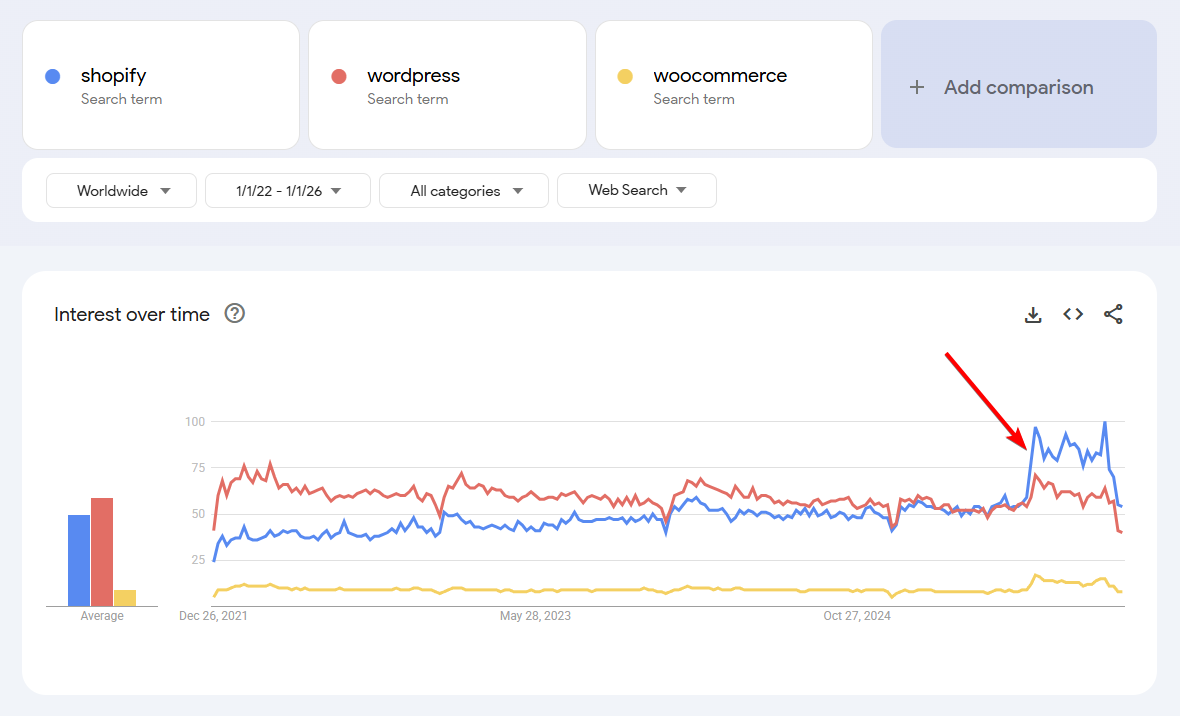
AI has disrupted the status quo. It’s killing basic, nice-to-have plugins. And Shopify is conquering Google Search Trends – clearly winning the branding war.
That said, Shopify is an old threat. WooCommerce businesses could plan around it. AI was the wild card and harder to anticipate.
This year, however, the community (product makers, developers, agencies) has clarity on what they are up against.
We asked the people in the trenches where they think WooCommerce is headed. Here’s what they said:
AI is Disrupting WooCommerce From Every Direction
In 2026 and beyond, there are 3 emerging AI-threats affecting WooCommerce businesses –
Threat 1: Customers are increasingly replacing simple plugins with custom AI codes.
Collins Agbonghama (Lead Developer of ProfilePress Membership Plugin) noticed a decline in sales for one of his plugins and wanted to get to the bottom of it.

“We sent out an email survey to our past customers, asking why they churned, and we discovered a number of agencies and website builders who chose our plugin primarily because of a small feature we offer, churned because they’ve been able to replace our plugin with an AI-assisted coded one.”
Years of recurring revenue – gone! Not to a real competitor. To AI.
As much as it hurts to admit, this is a new reality.
It’s worth noting, however, that Collins’ plugin added a “small feature” to websites. If there’s a lesson here, it’s this: simple plugins adding small features are going to become obsolete.
This also means that complex indispensable plugins will weather the storm relatively unharmed.
Threat 2: Amateurs are vibe-coding and flooding the ecosystem with insecure plugins.
On x.com and LinkedIn, I saw numerous marketers and content folks passionately building plugins and submitting them to the WordPress repository. Some plugins were accepted, others were rejected.
Brad Vincent (CEO of FooPlugins) has legit concerns about these plugins:

“Some people have the opinion that you can just vibe code a plugin from scratch. And this might be true for a lot of simple plugins. But there are 2 things you do not get from vibe coded plugins: support when things go wrong; an author who cares about the things you have not even considered (standards, WP core updates, security, etc).”
Enthusiasm surrounding a new technology is nothing new. But responsible handling of software is getting ignored amidst this desire to build software.
One agency reported finding 100 security issues in a single vibe-coded plugin on one of their client sites. One Hundred security issues in a Single Plugin!
Rigorous testing, constant improvement, and maintenance play a huge role in building software.
Lack of foresight and proper vetting will spell disaster in the future!
Here’s to a flip side to consider, though: Would increased headache with insecure vibe-coded plugins generate more work opportunities for developers and agencies?
Only time will tell!
Threat 3: AI is making it harder for customers to reach your store.
Traditional search giant, Google, reported a nearly 20% decline in user search as more and more people are turning towards AI to find answers.
AI is their first point of contact. Traffic from AI search then flows to established platforms like Google and YouTube, before reaching independent websites like a WooCommerce store.
Gareth Harris (Owner of Plugin Republic) thinks the AI-native era is transforming the buyer’s journey:

“AI is going to have a huge impact on store owners. It won’t just change how you build and manage your store, it will have an impact throughout the purchasing process – from how customers will discover your store, to how they interact with it, to even having AI initiate transactions on behalf of customers. It’s going to be profound.”
WooCommerce stores clearly need to prepare for AI-driven buyer discovery and decision-making. The problem is that there are very few data-driven insights on how to build those foundations, let alone which strategies are most effective.
“Experiment” is the name of the game right now!
Recommended posts and podcasts:
- Open Channels FM: Matt Mullenweg on WooCommerce’s Future and Competitive Strengths in Online Commerce
- WP Minute Podcasts: AI’s Role in the Future of WooCommerce
- Global survey: Data reveals shift to intentional shopping
WooCommerce is Losing the Perception War to Shopify
Last year’s Google Trends data shows Shopify overtaking WordPress.
WooCommerce is nowhere near WordPress or Shopify!
Shopify offers an all-in-one setup, strong default e-commerce UX, built-in payment, and global selling tools – it’s this hands-off approach that attracts beginners.
WooCommerce, on the other hand, is à la carte (as per your need). It’s often cheaper upfront, but the cost can exceed at scale, mainly due to developer time, maintenance, and plugin stacking.
Brad Vincent (CEO of FooPlugins) puts it plainly:
“Shopify has a lot of cool features built in that you have to pay a premium for in WooCommerce. I feel the barrier to entry for non-technical makers is much smaller with Shopify.”
Of course, Shopify has its own cost surprises too, such as transaction fees, app subscriptions, and plan jumps. But Shopify’s costs are more transparent upfront, whereas WooCommerce costs are unpredictable and hard to budget for.
Brad thinks that transparency is winning!
“Shopify has an edge right now from a brand POV, and WooCommerce’s market share will drop in 2026,” he predicts.
Recommended posts and podcasts:
- The WP Minute: The Challenges and Opportunities of WooCommerce
- The WPMinute: Can E-commerce Ever Be Simple?
- Open Channels FM: Your Questions, Answered by the People Shaping WooCommerce
- WP Tavern: WooCommerce’s Challenges and Innovations
Final Thoughts
So, was WooCommerce’s glow-up maturity or survival strategy?
Honestly, it doesn’t matter. Because both answers lead to the same place: adapt or fall behind.
The threats are real. AI is moving faster than anyone anticipated. Shopify is winning the perception war.
But none of this is a death sentence. The ecosystem is maturing, and so are the people building on it!
Remkus de Vries (WordPress Consultant and Educator at Truer than North) puts it best:

“As online businesses in general mature and scale up, so will those who build sites for those businesses. For 2026, I expect this trend to deepen and broaden even further. Leveling up is the name of the game for 2026.”
Question: What WooCommerce trend are you watching closely in 2026? Drop it in the comments.