
Many eCommerce stores struggle to grow because they operate without clear sales targets.
It becomes difficult to understand which marketing efforts are working, whether revenue is improving, or why certain months perform better than others.
Without defined goals, store owners often rely on guesswork, which leads to inconsistent results and missed opportunities.
Setting structured sales goals changes this. Clear targets help you focus on the actions that matter most, from improving product pages to refining your checkout experience.
Sales goals also make it easier to plan promotions, manage inventory, and track performance over time. With the right goals in place, your store can develop a more predictable and steady sales rhythm.
In this guide, you will learn what eCommerce sales goals are and why they matter for every type of online store.
We will walk through the different types of goals you can set, how to define them using the SMART framework, and how to choose the right goals based on your store’s stage of growth.
You will also learn simple ways to track your progress and adjust your strategy as your store grows.
Let’s get started.
What Are eCommerce Sales Goals?

eCommerce sales goals are clear, measurable targets that guide how your online store grows. They define the outcomes you want to achieve within a specific period, such as increasing revenue, improving conversion rates, or bringing in more repeat customers. By setting these targets, you create a simple roadmap that helps you focus on the areas that directly affect sales performance.
Sales goals can apply to your entire store or to specific parts of your operation.
For example, you can set goals for your product pages, marketing channels, checkout flow, or customer retention efforts. These goals help you stay organized, understand where to invest your time, and measure the impact of every improvement you make.
Benefits of Setting eCommerce Sales Goals
- Gives your store a clear direction so you always know what to prioritize.
- Helps you shift from guesswork to focused actions that support measurable growth.
- Encourages you to track key metrics, which show what is working and what needs improvement.
- Uses this data to refine product pages, marketing campaigns, and the checkout experience, including upgrading product visuals when needed.
- Improves decision-making because you can clearly see which areas deserve attention.
- Makes planning easier by guiding your promotions, budgets, and inventory decisions.
- Helps you respond quickly to changes in performance, since you can compare results against defined targets.
Clear and structured goals help you stay focused, improve key parts of your store, and make decisions that support steady, long-term growth.
Types of eCommerce Sales Goals
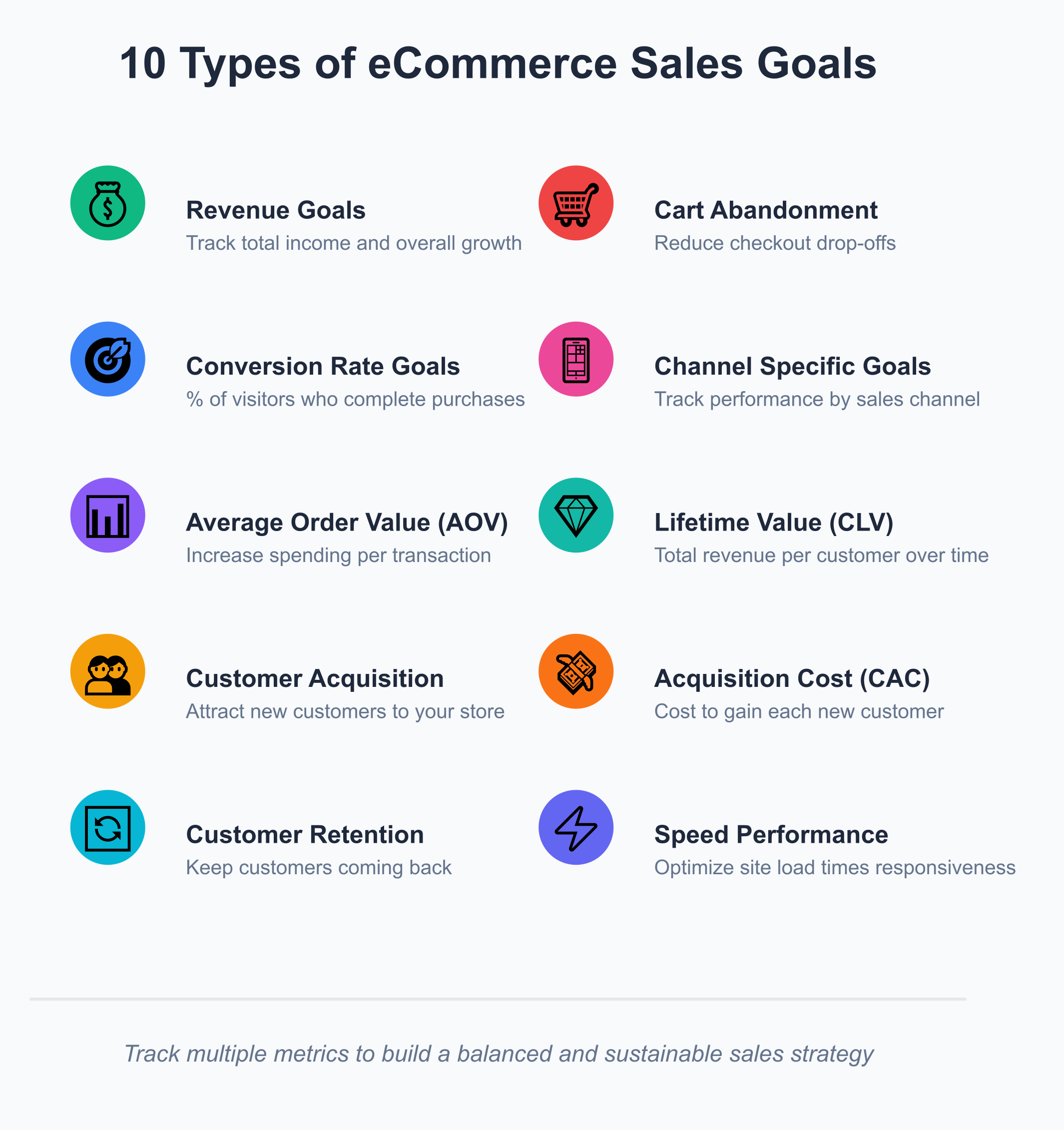
Sales goals can focus on many parts of your store, from revenue to customer experience. Choosing the right mix helps you understand how your store is performing and where you can make meaningful improvements. Below are the most common types of goals used by eCommerce businesses, along with simple examples for each.
- Revenue Goals: Track the total income your store generates. They are useful for understanding overall growth and for planning budgets and promotions.
- Conversion Rate Goals: Conversion goals focus on the percentage of visitors who complete a purchase. These goals often relate to improvements in product descriptions, images, store layout, or checkout flow, all of which contribute to stronger conversion performance.
- Average Order Value (AOV) Goals: AOV goals aim to increase the amount customers spend per transaction. Strategies like product bundles, frequently bought together suggestions, or free shipping thresholds often support these goals.
- Customer Acquisition Goals: These goals measure how many new customers your store brings in. They are often tied to SEO, social media, paid ads, or email list growth, and sometimes expanding into marketplaces. Acquisition goals help you track how effective your marketing channels are at attracting new shoppers.
- Customer Retention: Retention goals focus on keeping your existing customers engaged and returning. These goals are supported by loyalty programs, email reminders, strong customer service, and personalized offers.
- Cart Abandonment & Checkout Goals: These goals aim to reduce the number of shoppers who leave before completing payment. Improving checkout speed, simplifying the form fields, or adding trust signals can help more customers finish their purchase.
- Channel Specific Goals: Stores often sell through multiple channels, such as the website, social media, email, or paid ads. They make it easier to identify your strongest and weakest marketing channels.
- Customer Lifetime Value (CLV) Goals: CLV goals focus on increasing the total revenue you earn from each customer over time. These goals encourage better retention, stronger customer relationships, and consistent follow-up.
- Customer Acquisition Cost (CAC) Goals: CAC goals aim to reduce the cost of gaining new customers. They help you improve marketing efficiency and ensure that your paid campaigns remain profitable.
- Speed & Performance Goals: Store speed can significantly affect conversions. Goals that focus on load time, mobile performance, or checkout responsiveness often lead to higher sales.
Setting a variety of sales goals helps you track your store from different angles, not just revenue. Each type highlights a specific part of the customer journey and shows you where improvements can create the biggest impact.
By choosing goals that fit your current stage of growth, you can build a more balanced and sustainable sales strategy.
How to Set Effective Sales Goals Using the SMART Framework
Setting sales goals becomes much easier when you use a clear structure. The SMART framework helps you define goals that are specific, realistic, and easy to measure. This makes your progress easier to track and ensures that each goal supports your store’s overall growth.

Specific
A specific goal explains exactly what you want to achieve. Instead of saying you want “more sales,” define the exact outcome, such as increasing monthly revenue or improving your checkout completion rate. Clear goals remove confusion and help you plan your next steps with confidence.
Measurable
A measurable goal includes a metric you can track in your analytics. This allows you to monitor performance and see whether you are moving in the right direction. For example, tracking conversion rate, AOV, or the number of new customers helps you understand which improvements work best.
Achievable
Your goal should challenge you but still be realistic based on your current performance. Look at your past data to understand what is possible for your store. Setting achievable goals keeps you motivated and prevents frustration, especially during early growth stages.
Relevant
A relevant goal should support your broader business priorities. Make sure each goal aligns with the areas that matter most for your store, such as sales, customer experience, or profitability. When goals stay connected to your long-term plans, your daily decisions become more focused.
Time Bound
Every sales goal needs a clear deadline. A timeline helps you stay accountable and gives you a window to assess progress. Short time frames also allow you to adjust quickly when something is not working as expected.
The SMART framework turns vague ideas into practical, actionable steps. By applying this method to every sales goal you set, you create a structured plan that is easier to follow and easier to measure. This leads to steady improvements and a more predictable growth pattern for your store.
Choose the Right Sales Goals for Your Store Stage
Not every store needs the same type of sales goals. Your priorities will shift as you move from launching your business to maintaining steady growth. Choosing goals that match your current stage helps you stay focused and prevents you from taking on too much at once.
New stores benefit most from simple, achievable goals, especially if you are launching with minimal resources. Focus on getting your first customers, improving early traffic, and raising your conversion rate slightly. These goals help you understand your audience, test your product pages, and learn what drives sales.
Once your store starts receiving consistent orders and starts growing, shift toward goals that build stability. This might include improving your checkout completion rate, increasing average order value, or encouraging more repeat purchases. At this stage, you can use data to refine what is already working.
Scaling stores that have steady demand can focus on long-term growth and efficiency. Goals like improving customer lifetime value, lowering customer acquisition cost, or expanding into new channels may also require evaluating whether your platform can support future growth. These goals help you strengthen profitability and reach a wider audience.
Aligning your goals with your store’s stage keeps your strategy focused and manageable. As your business evolves, your goals will naturally change. Reviewing them regularly ensures you stay on track and continue building toward sustainable growth.
Tools & Tips to Track & Reach Sales Goals

Tracking your sales goals becomes much easier when you use the right tools.
- WooCommerce analytics is a strong starting point because it shows key metrics like revenue, orders, average order value, and repeat purchases.
- Google Analytics adds more detail by showing where your traffic comes from, how visitors move through your site, and which pages need improvement.
- Email marketing platforms also help you monitor list growth, campaign performance, and subscriber activity, while chatbots can support faster responses and higher engagement.
- A/B testing tools are useful for testing different versions of product pages, buttons, or layouts to see which one converts better.
Simple habits make a big difference when reaching your goals.
- Reviewing your numbers each week helps you catch changes early and adjust your strategy before issues grow.
- Starting with only one or two goals keeps your focus clear and reduces overwhelm. Small improvements, such as updating product descriptions or streamlining checkout, can have a noticeable impact when measured over time.
- It also helps to adjust your goals during seasonal peaks or marketing campaigns, since performance patterns often shift throughout the year.
By combining the right tools with consistent tracking, your goals become easier to manage and much easier to achieve.
FAQs
What are the 5 SMART goals for sales?
The five SMART goals are Specific, Measurable, Achievable, Relevant, and Time-bound. This framework helps you set clear targets that are easy to track and adjust. Using SMART goals ensures your sales strategy stays focused, realistic, and aligned with the results you want to achieve.
What is an example of an online sales goal?
A simple online sales goal could be increasing your store’s monthly revenue by 15 percent within the next 60 days. This type of goal is specific, measurable, and easy to track through your analytics. It gives you a clear target and helps you stay focused on improving sales performance.
What are some good sales goals examples?
Good sales goals can focus on many areas. Common examples include raising your conversion rate from 1 percent to 2 percent, increasing average order value through bundles, reducing cart abandonment by improving checkout, or gaining 200 new customers this quarter. Each goal supports growth and helps you measure progress consistently.
Conclusion
Sales goals are essential for building a focused and predictable eCommerce business. They help you understand what is driving growth, where improvements are needed, and how to allocate your time and budget with confidence.
When your goals are clear, every decision becomes easier, from optimizing product pages to planning promotions and improving the checkout experience.
Starting small is the key. New stores benefit from simple, achievable goals that build early momentum, while growing stores can refine their strategy with more targeted goals like improving AOV or raising repeat purchase rates.
As your store matures, long-term goals such as increasing customer lifetime value or lowering acquisition costs help strengthen profitability and stability.
Using the SMART framework keeps each goal measurable and realistic, so you always have a clear way to track progress. Regular reviews also play an important role, since they help you spot changes early and adjust your strategy when needed. Over time, these consistent steps lead to steady, sustainable growth.
That’s it for this one, folks! If you have any questions about e-commerce sales goals, let us know in the comments section below.