



The Advanced Posts block lets you create custom listings for posts, pages and other registered post types directly inside the WordPress block editor.
You can inherit an existing archive design from the Customiser or build a fully editable post template using nested blocks such as Dynamic Data. The resulting listing can then be displayed as a grid, list or slideshow, with its own query and pagination settings.
Blocksy Companion required
The Advanced Posts block becomes available after installing and activating Blocksy Companion.
Getting Started
Add the Advanced Posts block from the WordPress block inserter. When the block is inserted for the first time, you can choose how its initial post template should be created.
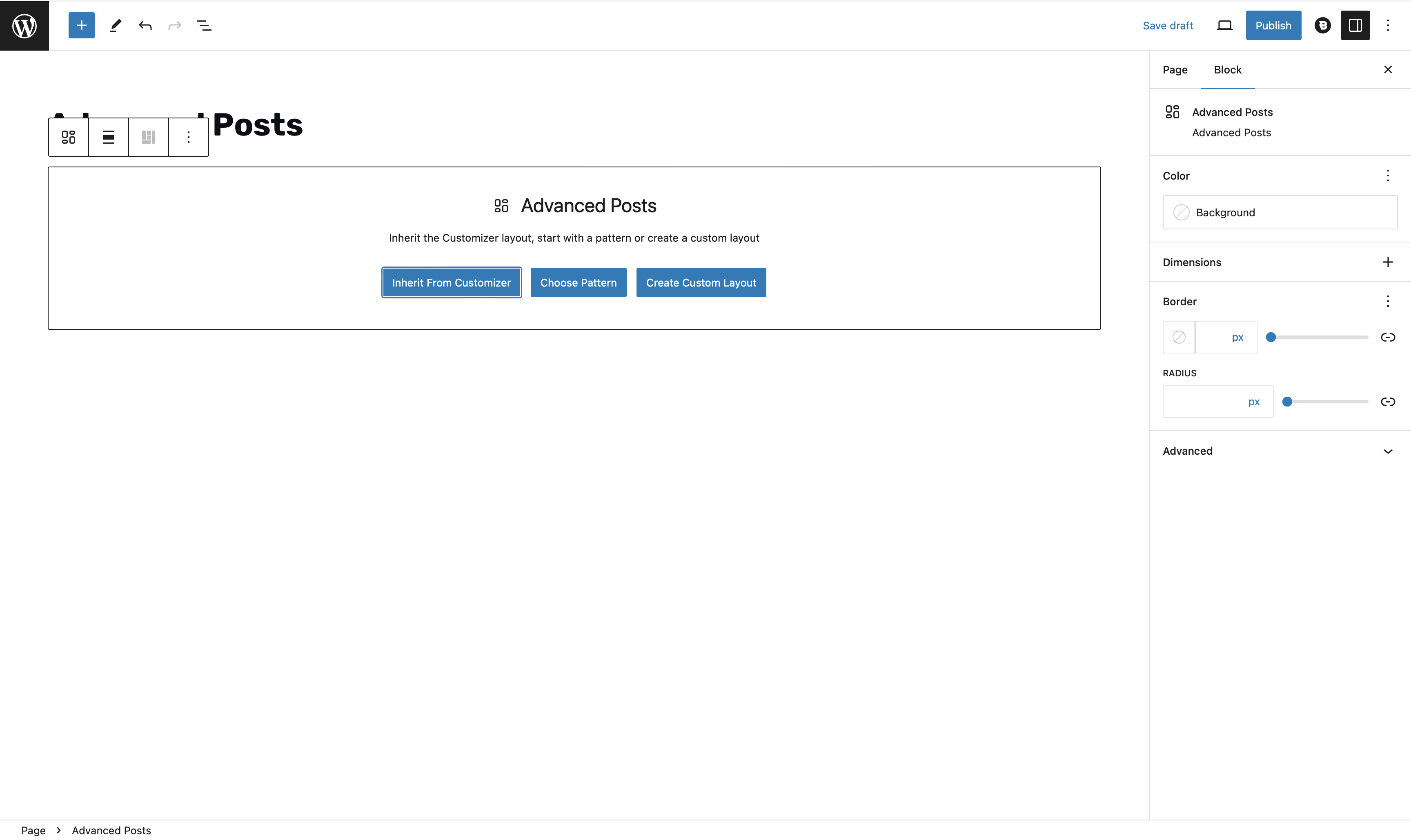
Inherit From Customiser
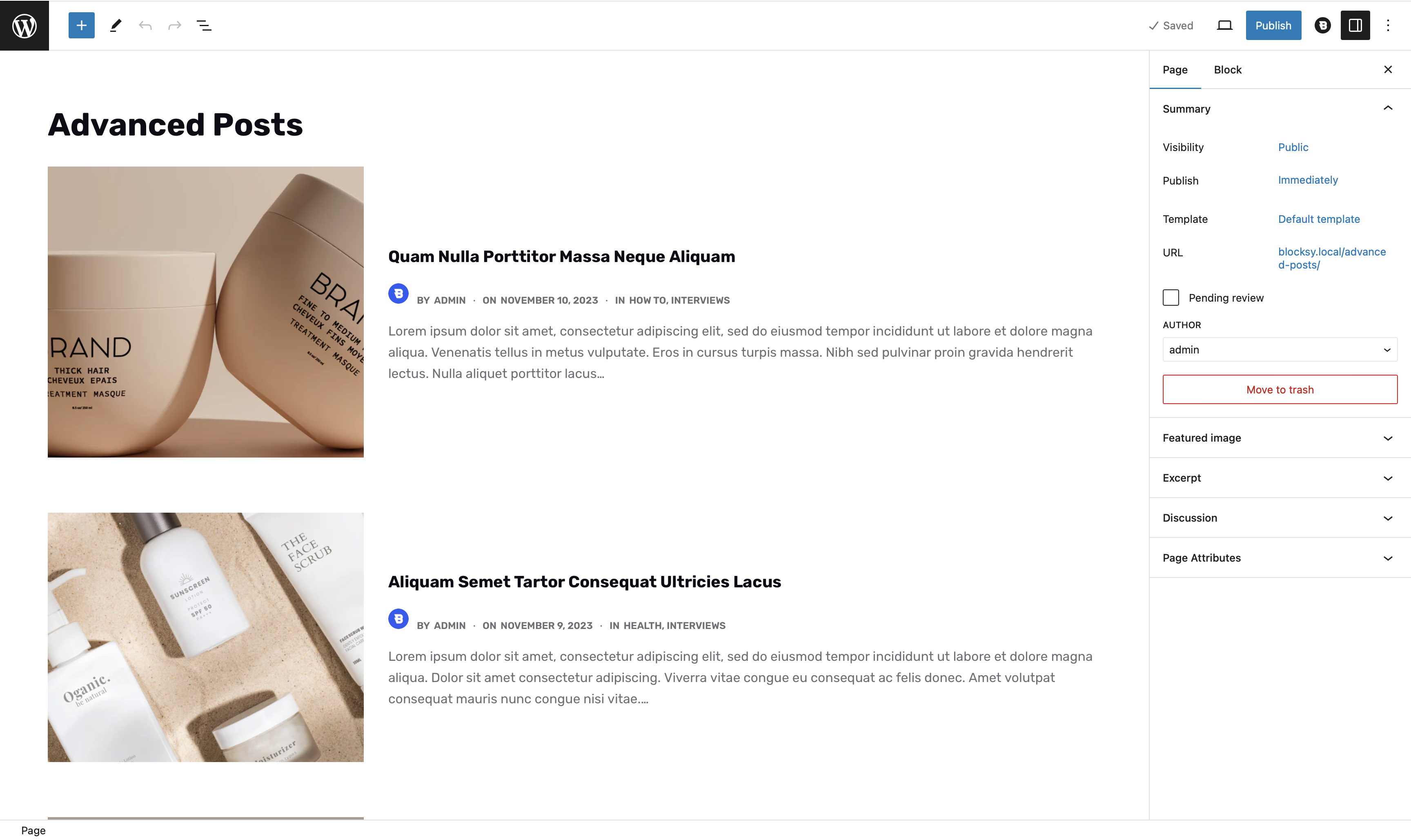
Use Inherit From Customiser when you want the block to reproduce the archive card design configured through Blocksy’s Customiser settings.
This provides a quick way to maintain visual consistency with an existing archive, but the individual elements of the inherited post card are controlled by the corresponding Customiser options rather than being independently editable as nested blocks.
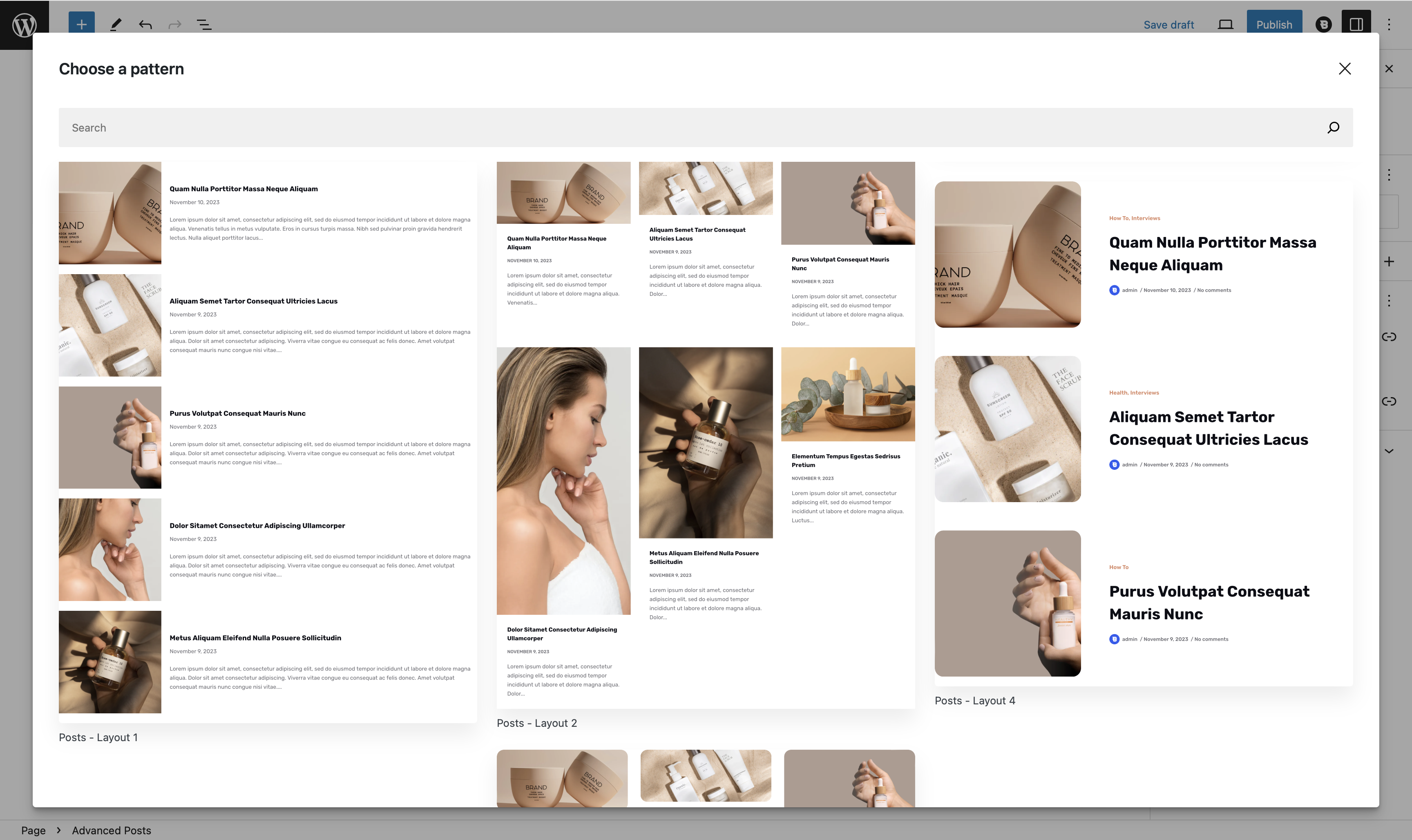
Choose Pattern
Select Choose Pattern to start from one of Blocksy’s predefined post-card layouts. The selected pattern remains editable, so its nested blocks can be rearranged, removed or extended after insertion.
Create Custom Layout
Select Create Custom Layout when you want to build the post card from an empty template. You can then add the blocks required for your design and arrange them freely inside the Post Template.
Granular Controls

Post Type
Select the type of content that should be queried by the block. Depending on the post types registered on your website, this can include regular posts, pages and Custom Post Types.
Post Count
Choose how many entries are displayed at a time. When pagination is enabled, this value also determines the number of items shown on each page of results.
Slideshow
Enable Slideshow to turn the post listing into a horizontal carousel instead of a regular grid or list.
Additional slideshow controls let you configure navigation behaviour, including:
- Navigation Arrows – show controls for manually moving between slides.
- Navigation Pills – display pagination indicators for navigating between groups of slides.
- Autoplay – automatically advance the slideshow and configure the interval between transitions.
Pagination
When the query contains more content than the configured Post Count, pagination can be used to expose additional results.
Depending on the selected configuration, the block can use traditional page navigation or dynamic loading behaviours such as loading additional results without rebuilding the complete page.
Query Parameters
The block includes additional controls for refining which entries are returned and how they are ordered.
Offset
Use Offset to skip a specified number of entries at the beginning of the query. This is useful when the first few posts are already being displayed elsewhere on the same page and should not be repeated.
Order & Order By
Choose the criteria used to sort the queried content and whether the resulting order is ascending or descending. Available criteria can include values such as publication date, title, author and other supported WordPress query properties.
Sticky Posts
Control whether posts marked as Sticky receive their normal special treatment or are handled like regular entries in the query.
Taxonomy Filtering
Refine the query using taxonomies associated with the selected post type. For example, a posts listing can be restricted to specific categories or tags, while Custom Post Types can use their corresponding custom taxonomies.
Terms can be included or excluded, making it possible to build listings focused on a precise subset of your content.
Custom Queries
Developers who need query behaviour beyond the available editor controls can modify an individual Advanced Posts query programmatically using Blocksy’s query filter and the block’s unique ID.
See Custom Queries for Advanced Posts blocks for an implementation example.
Building the Post Template
When you use a pattern or create your own layout, each queried entry is rendered through the nested Post Template block. The blocks placed inside it define the structure that is repeated for every result.
Dynamic Data
The Dynamic Data block can retrieve information from the post currently being rendered by the template, including its title, featured image, excerpt, author, date, taxonomy terms and other supported data sources.
You can add multiple Dynamic Data blocks and configure each one for a different source, then rearrange or remove them like regular WordPress blocks.
Content Blocks
A Content Block can also be placed inside the Post Template when Blocksy Pro is active. This lets you reuse a separately designed Content Block as part of every rendered post card.
This can be useful when a repeated section of the card is already maintained as a reusable Content Block or when you want to build more complex layouts without recreating the same structure inside every Advanced Posts instance.
Grid & List Layouts
The Post Template can be displayed using either a Grid or List arrangement. Choose the structure that best fits the amount of information shown by each post card and the available width of the surrounding layout.
When No Results Are Found
If the configured query does not match any content, the Advanced Posts block can display a dedicated no-results message instead of leaving the area unexplained. This is particularly useful for narrowly filtered queries where the available content may change over time.