



The Account element gives visitors quick access to login, registration and account-related actions directly from the Blocksy Header Builder. Its behaviour can be configured independently for logged-in and logged-out visitors, making it suitable for regular WordPress websites as well as WooCommerce stores.
To use it, open the Customiser → Header, drag the Account element into the desired header row or supported area, and select it to configure its options.
Blocksy Companion required
The Account element requires the Blocksy Companion plugin to be installed and activated.
Granular Controls
The Account element provides separate controls for visitors who are logged in and those who are logged out. This lets you define different actions, visuals and labels for each state.
Logged-In State
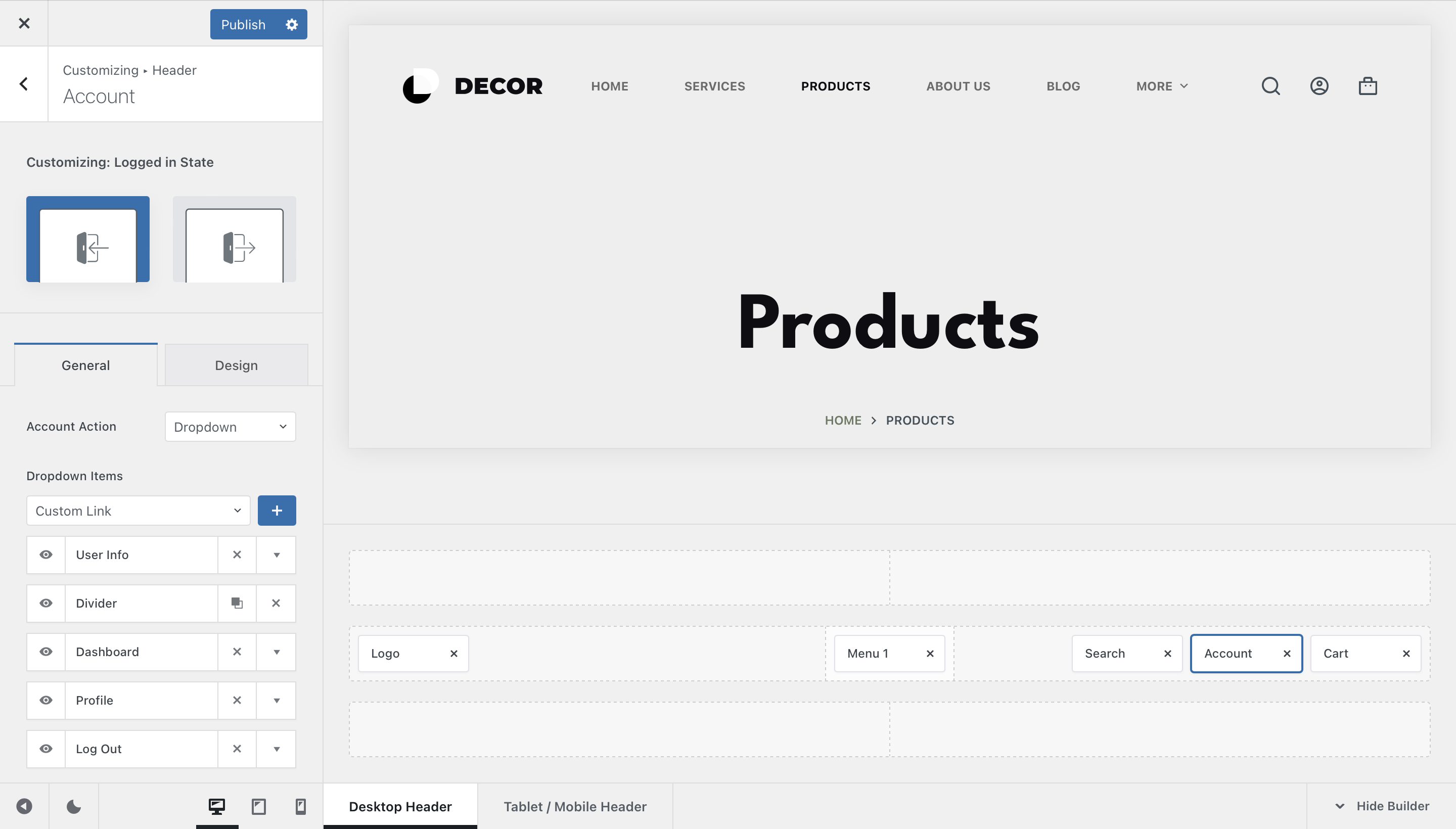
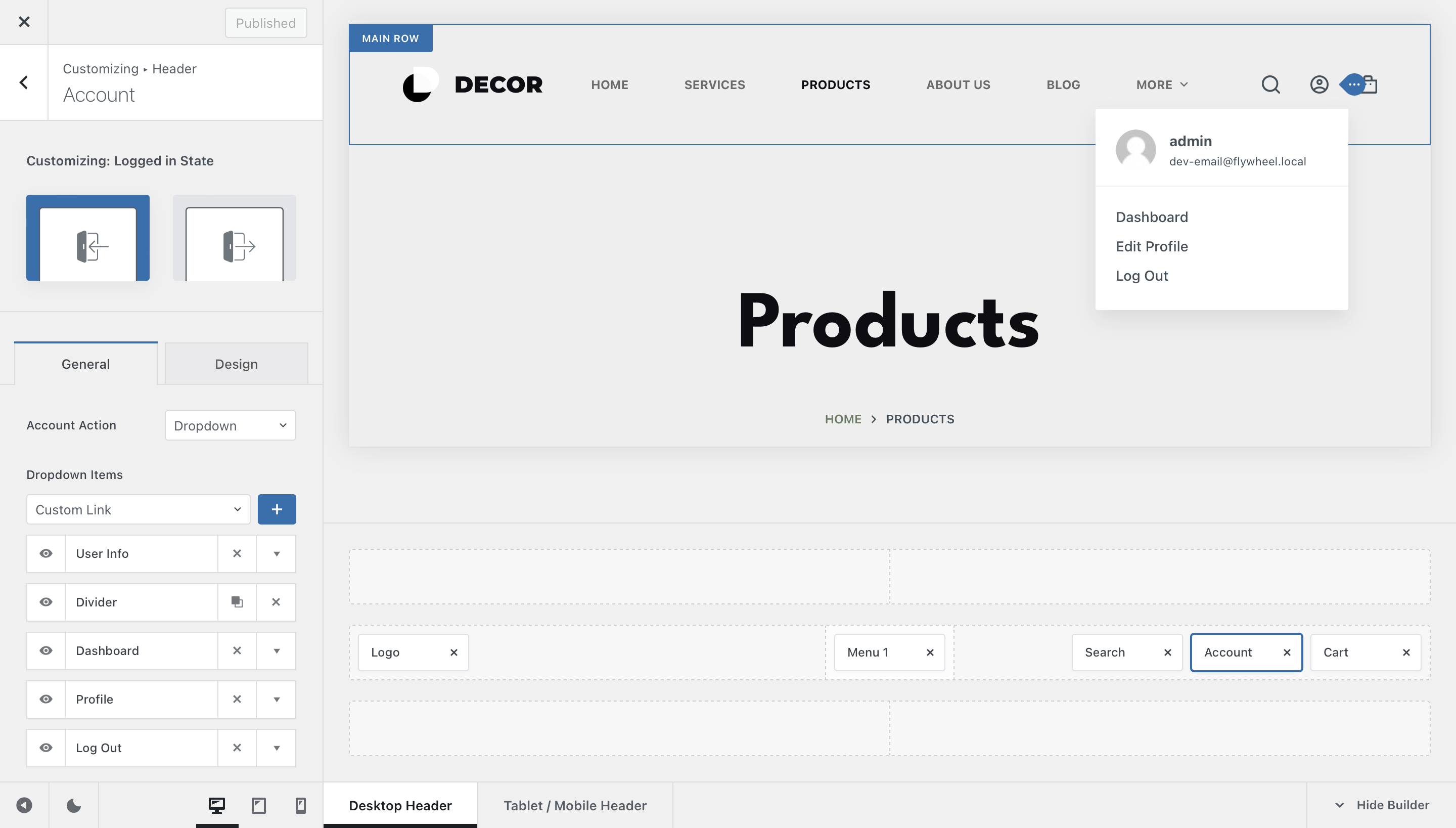
For logged-in visitors, the element can either open an account dropdown or work as a direct link to a selected destination.

Account Action
Choose how the element behaves when a logged-in visitor interacts with it.
Dropdown
The Dropdown option opens an account menu containing configurable user information and actions. Depending on your setup, this can include the user’s avatar and account details, navigation menu items, custom links and a logout action.
Link
The Link option turns the Account element into a direct shortcut. Available destinations include:
- Profile Page – opens the user’s WordPress profile.
- Dashboard Page – opens the WordPress dashboard.
- Custom Link – redirects the visitor to a URL of your choice.
- Logout – logs the current user out.
- WooCommerce Account – opens the WooCommerce My Account page.
Account Image
Choose the visual displayed by the element. Logged-in visitors can be represented by their avatar, one of Blocksy’s built-in icons, or no image at all when you prefer to rely on the text label.
The image or icon size can also be adjusted independently.
Label Visibility
Control whether the Account element’s text label is displayed on each responsive device. This lets you use an icon-only presentation on smaller screens while retaining a descriptive label on desktop, for example.
User Visibility
The User Visibility setting controls whether the element itself is available to logged-in users, logged-out visitors, or both.
This can be useful when you want to present different account-related elements or calls to action depending on the visitor’s authentication state.
Logged-Out State
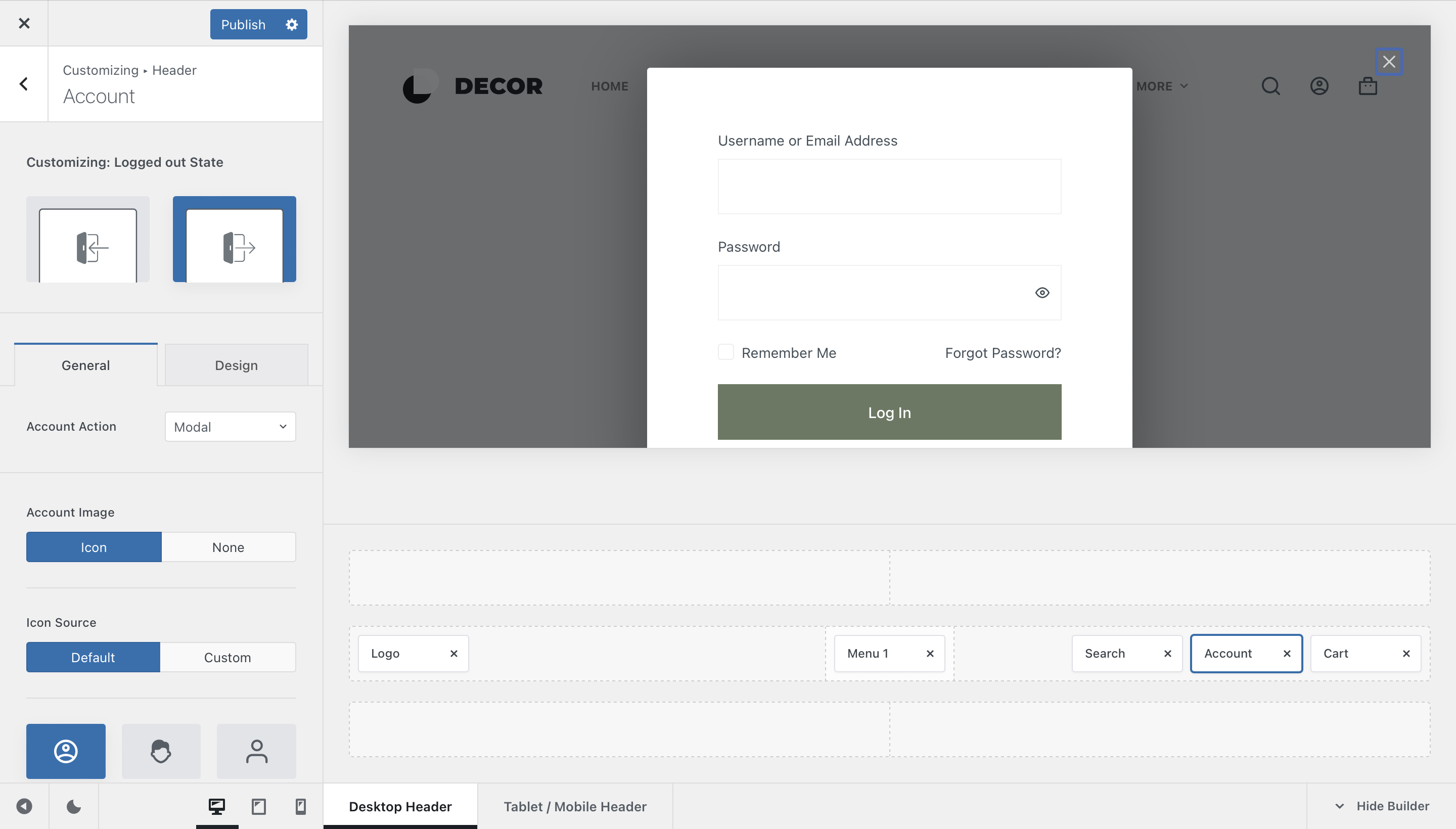
Logged-out visitors receive a separate set of actions focused on authentication and reaching the appropriate account page.
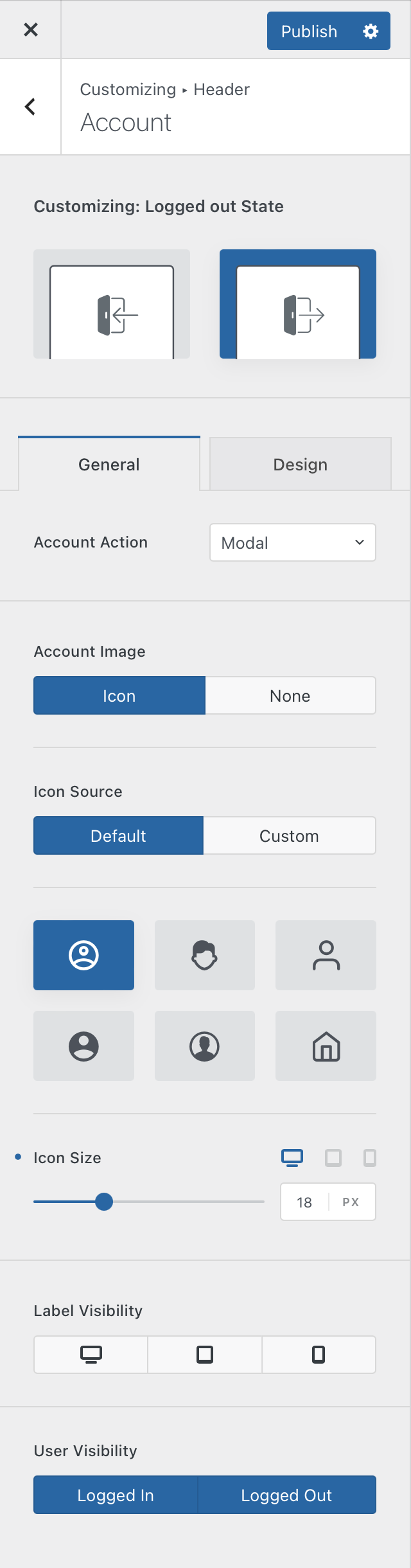
Account Action
- Modal – opens Blocksy’s built-in account interface, allowing visitors to log in and, when registration is enabled, create an account. Password recovery is also available through the modal.
- Custom Link – redirects visitors to a URL of your choice, such as a dedicated membership or authentication page.
- WooCommerce Account – redirects visitors to the WooCommerce My Account page.
Account Image
For logged-out visitors, you can display one of Blocksy’s built-in account icons or hide the image entirely and use only the element’s label.
The icon size can also be adjusted to match the surrounding header elements.
Registration availability
The registration form is displayed only when account registration is enabled by WordPress or the relevant WooCommerce account settings. Blocksy respects the registration configuration of the website rather than enabling new-user registration on its own.
Label Visibility
Control whether the Account element’s text label is displayed on each responsive device. This lets you use an icon-only presentation on smaller screens while retaining a descriptive label on desktop, for example.
User Visibility
The User Visibility setting controls whether the element itself is available to logged-in users, logged-out visitors, or both.
This can be useful when you want to present different account-related elements or calls to action depending on the visitor’s authentication state.
Blocksy Pro Enhancements
Blocksy Pro extends the logged-out account modal with additional registration behaviour and integrations for WooCommerce, social login and security plugins.
WooCommerce Registration
When WooCommerce registration is being used, Blocksy Pro can integrate its account creation options directly into the modal, including support for registration fields such as a custom username and password where the WooCommerce configuration allows them.
Third-Party Integrations
The Account element and its modal integrate with a selection of third-party authentication and security solutions. Supported integrations include services for CAPTCHA protection, social login and two-factor authentication.
- Advanced noCaptcha & invisible Captcha
- All-In-One Security (AIOS)
- Login No Captcha reCAPTCHA
- Nextend Social Login and Register
- Wordfence Login Security
- Simple Cloudflare Turnstile
- WP 2FA by Melapress
Blocksy also includes compatibility improvements for other authentication and security solutions. Because these integrations can evolve alongside the third-party plugins themselves, keep Blocksy, Blocksy Companion and the integrated plugin up to date.